Bu Blogda Ara

İzleyiciler

Sayfalar

Galata etiketine sahip kayıtlar gösteriliyor. Tüm kayıtları göster

9 Şubat 2012 Perşembe

Kanto / Canto


Leblebici Horhor

Peruz Hanım


 GALATA DİREKLER ARASINDA; 
                                            Süzülen Nağmeler  


Kanto için etekleri zil çalan bir müzik türü diyebiliriz. Müzik ve raksın bir arada güçlü bir dişi perspektifle yorumlandığı bu tür; Osmanlı- Türk kültürünün ilk popüler müzik türü olmasının yanı sıra kadın kimliğinin ilk defa sanatsal ve kültürel açıdan ön plana çıkmasını sağlamasıyla, tarihimizde önemli bir yere sahiptir.

Galata’ya gelen bir gezgin İtalyan tiyatrosunun sahne almadan önce söylediği şarkıların büyük beğeni toplamasıyla, oluşan bu türün adı, İtalyanca şarkı söylemek anlamına gelen cantare’den türetilir. Kanto, tiyatro öncesinde program hakkında bilgi veren, ayrıca teatral özellikler taşıyarak, söyleyen kişinin jest ve mimiklerle güfteyi pekiştirmesini gerektiren danslı ve müzikli bir tür olarak ortaya çıkar. Bununla beraber daha sonra tiyatroyla göbek bağını keserek, müzikal bir form olarak gelişir.

Kanto ilk olarak kadınlar tarafından icra edilmiş, daha sonra erkekler bu türe destekleyici ve yan unsur olarak katılmışlardır. Peruz, Virjin, Şamran, Kamela, Agaumi, Pipina, Büyük Mori, Eleni, Büyük Amelya, Küçük Amelya, Minyon, Flora, Aranik, Maltit Viktorya, Anjel bu dönemin en popüler kantocuları arasında yer alır. Eğlenceli atışmaların da yer aldığı bu türün en eğlenceli örneklerinden biri Karı Koca Kantosu’dur.

KADIN: Koca bıktım senin her gece bu bitmez tavrından
            Hiç utanmıyor musun sen karşındaki komşundan
            İçme derim içersin kendinden de geçersin
            Zaten senin neyine hiç gelme evime

ADAM: A be karı ne istiyorsun sen benim rakımdan
            Odur ki beni kurtaran her türlü merakımdan
            İçme dersin içerim kendimden de geçerim
            Daha fazla söylenme; senden de vazgeçerim

KADIN Haydi çık dışarıya; İstemem böyle koca
             Aman usandım senden; defol git dışarıya…

İlk kantoya çıkan sanatçı, Kantocu Arnik Hanım olmasına rağmen; ilk olarak popülerleşen isim Peruz Hanım olmuştur. Cemal Ünlü, Peruz Hanım’ı kantoyu incelediği eserinde şöyle tanımlar: “ Kaşta gözde bol rastık ve sürme, başta arkaya dökülmüş saç, sırt, göğüs ve kolları dekolte, dizkapağı boyunda yavruağzı, kanarya sarısı, camgöbeği veya filizi, rengarenk pullu yanar döner kemerli bol saçaklı fistan. Çiğ pembe çorap, ponponlu ve sırmalı iskarpinler.”
Tabi bu tarz kıyafetler, sadece Peruz Hanıma ait bir tarzı betimlemez. Kantonun ruhuna uygun olarak giyinen pek çok kadın sanatçı; sözlerle hüznünü paylaşsa da; genellikle “bu da geçer gider” diye bir nağmenin notaların arasına saklandığı bu türe, uygun neşeli, canlı kıyafetleri giymeyi tercih eder.

Ahmet Rasim Bey, Fuhş-i Atik kitabında Galata tiyatrolarını ayrıntılı bir biçimde anlatır. "Peruz daha işveli, daha marifetli, daha şehvetli daha munis görünüyordu. Onun için tiyatronun sahneye yakın yerleri dopdolu bulunurdu. Tersane topçu neferlerinden, sıkma potur üstüne kukuletalı sako giyimli natırlardan, tellaklardan, hafiyelerden, mavnacı, salapuryalardan tütün da kalem mümeyyizlerine, on dört on beş yaşlarında çocuklara varıncaya kadar herkes buralarda yerini alır. O zaman Peruz için derlerdi ki: Çok kimsenin katili olmuş çok gencin canını yakmış bir kahpedir… Şarkısını bitirdi mi, localardan sandalyeler, çiçekler, buketler, fiyonklu mektuplar atılır, şangırtı, hüngürtü, patırtıdan bina yıkılacak zannedilirdi. Rakipler arasında tokattan, sopa, usturpadan başlayan çekişme, ustura, bıçak, demir çekme, bazen de tabanca atmakla son bulurdu.”

Gerçekten de Peruz ve öteki kantocular için bu türden sonu acı biten pek çok sevda hikayesi anlatılır. Peruz'un Ayvansaraylı hamal kahyası bir sevgilisi olduğu, ona sıkı sıkıya bağlı ve sahneye savrulan paralara yan gözle bile bakmayacak; pas vermeyecek, namuslu bir kadın olduğu da söylenir. "O sadece çiçeğe meraklıdır. Kim bir çiçek atarsa onu alır, koklar ve göğsüne takardı".

Bu Galata tiyatrosu hikayelerinin en acıklısı da, Agavni isimli bir Ermeni kantocunun başından geçenlerdir. İki erkeğin rekabeti neticesinde belalısı 'Mart Dokuzu' tarafından sahnede kurşunlanır ve kendisine aşık, saraya mensup bir paşanın sahneye fırlattığı çiçek demetinin yanında can verir.

Bütün bu tatsız olaylara karşın; kanto oldukça kuvvetli mizahi bir yapı barındırır. Kantolarda ayrılıklar, kalp kırıklıkları, eski aşklar; “pek güzeldin, pek latiftin; börek olsan seni yerdim; az soğanlı, bol etliydin; lafa daldım, dibin tuttu; gönül bu hemen unuttu” gibi, genellikle mizahi bir dille anlatılır.

Kantoyla beraber kadınlar daha güçlü bir kimlik edinir ve erkeklere neredeyse meydan okuyan parçaları seslendirirler. Pek çok kadın sanatçı, kendi yazdıkları besteleri seslendirirken, gayet cüretkar ve alaycı bir yaklaşıma sahiptirler. Aynı zamanda kantolar, yazıldıkları dönemin modasına, yaşam tarzına ilişkin ipuçları taşırlar. Kantoların ele aldığı konular içinde, kadınların Cumhuriyetle edindikleri yeni kimlik sık, sık alay ve eleştiri konusu yapılır. Bana Sarhoş Kız Derler ve Kadın Şoför kantoları sanki erkeklerden, geçmiş günlerin öcünü almak üzere söylenir.

Kadın Şoför:   Bana kadın şoför derler
                        Aşarım uçan kuşu
                        Bana deli şoför derler
                        Tırmanırım yokuşu
                        Yolda kornamı çalarım
                        Erkekleri parçalarım

Cumhuriyet döneminde güncel olan konulardan biri de; o zamanlar Daktilo diye anılan sekreterlik kurumudur. “Daktilo daktilo küçücük daktilo; telefon başındayım alo… Gönüller yakarsın, peşine takarsın, keklik gibi sekerek kaçarsın…” şeklinde sekreter kadınları anlatan kanto dönemin popüler kantoları arasında yer alır. Aynı dönemin başka bir popüler kanto örneği de Evlilik Kantosu’dur.

Erkek: Bu bekarlıktan bıktım usandım; metreslerimden hiç tat almadım
Bayan: Bu bekarlıktan bıktım usandım; nasiplerimden hiç tat almadım
Erkek: Şimdi var bir arzum, evlenmektir kararım; lakin münasip bir bayan nerden bulayım? Bayan: Şimdi var bir arzum, evlenmektir kararım; lakin münasip bir koca nerden bulayım? Erkek: İşte bir bayan pek mini mini; acep söylesem sever mi beni?. Matmazel bana verir misin elini?
Bayan: Al efendim bu elin sensin sahibi
Erkek: Matmazel bana verir misin kalbini?
Bayan: Al efendim bu kalbin sensin sahibi
Beraber: Bizi görenler sakın korkmasınlar ;bir eş bularak mutlu olsunlar.

Zamanla kanto bir müzik terimi olmaktan çok bir tanım, bir genelleme özelliği kazanır. Zamanın kural ve gelenek dışı, hafif, günün beğenisine yönelik ürünlerine genel bir tanımla, Kanto denilmeye başlanır. Bu tür sonunda oldukça yaygınlaşır. Geniş halk yığınlarınca benimsenip, sevilir. Bir orta sınıf kent kültürü, İstanbul kenti ürünüdür artık. Bu yüzyılın başında, günümüz pop sanatının bir erken habercisi olarak kendisini kabul ettirmeyi ve yarım yüzyıla yakın bir zaman gündemde kalmayı başarır. 1950'lerden sonraysa sadece Ramazan nostaljisi olarak radyo programlarında anılır. Daha sonradan Nurhan Damcıoğlu, Meral Küçükerol, Oya Alasya gibi sanatçılar, kantoyu gazino eğlence programlarına dahil ederek yaşatmaya çalışırlar.

Bir modadan bir nostaljiye dönüşen süreciyle kantoya bakıldığında, batı etkisiyle ortaya çıkan ama bizim ürünümüz olan bu türün, sadece icra eden sanatçıların ötesinde bir kadın kimliği oluşturduğu ve kitleleri etkilediğini rahatlıkla söyleyebiliriz. Bir dönemin şehirli kadınının yaşantısının izlerini taşırken; aynı zamanda onun kimliğini pekiştiren, onu öven ve daha cesur olmasını teşvik eden sözleriyle modern şehirli kadına yeni bir ufuk açar.

Son yıllarda yorumlanarak tekrar dillere düşen “Ben kalender meşrebim” kantosunun sözleri düşünüldüğünde, “gönlüme bir eğlence isterim olsun” diyen bir kadın portresine, günümüzde bile az rastlanırken; o dönemde bunları sahneleyen, cesur yürekli kadınların önünde bir kez daha saygıyla eğilmek gerekir. 


 MELODIES that DRIFT from Galata to Direklerarası  

 
We can define Kanto as a music type with skirts that chime cymbals. It’s a form that is interpreted with a powerful female perspective with music and dance together; besides being one of the first types of popular music in the Ottoman – Turkish culture, it holds an important place in our history for ensuring the first time that the woman’s identity, from both an artistic and a cultural aspect, was put in the foreground. 


With the garnering significant praise for songs sung prior to a wandering Italian theater taking the stage in Galata, the name of this type is a corruption of ‘cantare’, meaning to ‘sing a song’ in Italian. Kanto emerged as a type with dancing and music, the lyrics of which need to be reinforced with the singer’s gestures and mimics. Moreover, it provides information about the program prior to the theater and bears theatrical characteristics. Along with this, it developed into a musical form by cutting its umbilical cord with theater later on.


Kanto was first performed by women, and later on, men joined up this type as a supportive side element. The most popular performers of kanto during this period were; Peruz, Virjin, Şamran, Kamela, Agaumi, Pipina, Büyük Mori, Eleni, Büyük Amelya, Küçük Amelya, Minyon, Flora, Aranik, Maltit Viktorya, and Anjel. The most amusing examples of this type, which also features some entertaining quarrels, is the ‘Husband & Wife’ Kanto.

WOMAN: Husband, I’m fed up with your never-ending behavior
                Aren’t you embarrassed from our neighbor?
                I say, “don’t drink,” you drink anyway and get drunk
                Don’t even bother coming home at all

MAN: Jeez, woman, leave me (my or this on purpose?) rakı alone.
                It saves me from all sorts of curiosity.
                You say, “Don’t drink”, but I’ll drink and I’ll lose myself.
                Don’t start with me, or I’ll lose you as well

WOMAN: Go on, beat it, I don’t want such a husband
                Man, I’m fed up with you, go on, beat it …

Though the first artist to do kanto was Kantocu Arnik Hanım, the first one to make the style popular was Peruz Hanım. This is what Cemal Ünlü (wrote?) about Peruz Hanım’s version of kanto: “She had a lot of kohl and eyeliner around her eyes and eyelashes. Her hair flung towards the back. She had a low cut dress, exposing her cleavage and arms - a pinkish orange, canary yellow or glass-green knee-high dress with lots of tassels and a glittering garish belt with colorful sequins as well as raw pink stockings and low cut shoes embroidered with silver thread and pompoms.”
Of course, such outfits don’t describe a style that was unique to Peruz Hanım. Though they conveyed a sense of melancholy, many women artists who dressed according to the spirit of kanto preferred to wear lively, enjoyable outfits in line with this type of music, while generally hiding amongst the notes of a tune called “bu da geçer gider” (eh, forget about it). 
In his book Fuhş-i Atik, Ahmet Rasim Bey wrote about the Galata theaters quite explicitly. "Peruz looked more coquettish, more talented, more voluptuous, and more sociable. That’s why the seats closer to the stage were packed. Artillery seamen from the shipyard, bath attendants wearing hooded jackets over tight jodhpurs, sleuths, barge operators, lighter operators, tobacco and pen examiners, as well as teenagers as young as 14 or 15 years old all taking their places. This is what they had to say about Peruz: She was a harlot who murdered a lot of guys and broke the hearts of a lot of lads… As soon as she finished her song and dance, chairs from the box seats, flowers, bouquets, letters wrapped in bowties would be tossed onto the stage, and there was so much noise in the joint, we thought it was going to collapse! What started as slaps, clubs and rope heatedly exchanged between rivals ended up as switchblades, knives, pipes and the occasional 
pistol.” 
Well, there were a lot of passionate stories regarding Peruz and other kanto performers that finished up in bitter fashion. Peruz had a lover who was a chief porter in Ayvansaray, who said she wouldn’t even look at the money bundled up and thrown up stage and that she was a honorable woman. "She was only fond of flowers. She would take the ones tossed up onto stage, sniff them and pin them to her bosom." 
The most pathetic of this Galata theater stories involved an Armenian kanto singer named Agavni. As the result of competition between two men, she is shot on stage by a ruffian named 'Mart Dokuzu,' and she dies next to a bouquet of flowers tossed onto the stage by a general from the palace who was in love with her. 
Despite all such unpleasant incidents, kanto had a lot of rather strong streak of comedy built into it as well. With kanto, separations, broken hearts, former loves would be generally told with a large dollop of funny bone. For instance, “You were really fine, really elegant, if you were a ‘borek’ I would have gulped you down; you had lots of meat but few onions; caught up in conversation, I forgot and burned your bottom, and my heart forgot you, I fathom.”
Women acquired a more powerful identity with kanto whereas they’d sing songs that would really take the piss out of the guys. Many of the woman artists would write their own lyrics, which had a tendency to be quite audacious and cynical. At the same time, kanto tunes bore clues pertaining to the fashions and lifestyle of the period they were written in. Amongst the topics put on the kanto chopping board was the new identity that women acquired with the Republic. Songs such as Bana Sarhoş Kız Derler (They Call Me the Drunken Maiden) and Kadın Şoför (Woman Driver) were sung to get back at men for all the nasty things they did to women in the past. 

Woman Driver:   The call me the woman driver
                                I fly over the flying bird
                                They call me the crazy driver
                                I hit the hills at top speed
                                I honk my horn on the road
                                I tear men apart

One of the current topics during the Republic period was the secretary temp institution called ‘Daktilo.’ One of the era’s most popular kanto tunes that described the plight of secretaries went something like this: “Typewriter, typewriter, tiny little typewriter; I’m next to the phone, hello … you break hearts, run after them, skip and flutter away like a partridge …” Another kanto hit that came out around the same time was the ‘Marriage Kanto’.

Guy: I’ve had it up to here with this bachelor life, I didn’t get off on my mistresses at all
Doll: I’ve had it up to here with this bachelorette life; I didn’t get off on my full share
Guy: Now I have this desire to get married; where am I going to find a wife who suits me?
Doll: Now I have this desire to get married; where am I going to find a husband who suits me?
Guy: Ah, here’s a lady, quite petite; I wonder if she would accept my good graces? Mademoiselle, would you please give me your hand?
Doll: Take it sir, you’re the owner of my hand now.
Guy: Mademoiselle, would you please give me your heart?
Doll: Take it sir, you’re the owner of my heart now.
Together: Don’t anyone be fearful of us, let them be happy by finding a spouse.

Over time, kanto went from being a music term to more of a definition, a generalization. Products that were non-traditional and a risqué for the times, light, and of the ‘Flavor of the Day’ genre generally began to be referred to as ‘Kanto.’ Eventually, these types became commonplace, and they were loved and appreciated by a vast segment of the population. The middle-class urban culture had become closely associated as a product of the Istanbul metropolis. As the harbinger of today’s pop music culture, kanto garnered a remarkable amount of acceptance toward the beginning of the 20th century and managed to remain fresh and vigorous for close to half a century. After the 1950's it was featured on radio programs only as Ramadan nostalgia. Later on, there was an attempt to revive kanto as part of the ‘casino’ entertainment programs, with artists such as Nurhan Damcıoğlu, Meral Küçükerol and Oya Alasya.

In taking a look at how kanto went from being fashionable to nostalgic, we can easily say that this type, which emerged with western influences but was strictly a domestic product, had an impact upon a wide segment of the population, and that women gained a formidable identity above and beyond that of a stage performer. While it bore the traces of the lifestyles of urban women of a certain era, it led to new horizons for modern urbanites with encouraging words of praise and courage, as well as consolidating their identities.
Reviewing the lyrics to a kanto that was turned into a cover tune in the recent years, “Ben kalender meşrebim,” (I’m a bohemian tramp) “I want some entertainment that is light-hearted,” we can infer that the woman portrayed here is rarely encountered today. In short, we all need to make one more bow in respect to the gutsy women who took to the stage all those years ago.      


8 Şubat 2012 Çarşamba

Beyoğlu Tarihi


The area known as the heart of Beyoğlu is what is known today as Galata. The oldest known name of this region is ‘Sike,’ which means ‘Fig Trees’ in Greek. Though we know that the         Romans, who captured the area in 146 B.C., called it ‘Sycena’, we have a difficult time trying    to determine when that name was first  used. What we definitely know is that when today’s İstanbul walked onto history’s center stage in 330 A.D. as ‘Deutera Romi’ (Second Rome), the official name of the city’s 13th Administrative Zone was ‘Regio Sycena.’ While it was officially known by its Latin name of ‘Regio Sycena’ and by the inhabitants its Greek name of ‘Sike’, Though it was called Justianinoplis once the Byzantine Emperor Justinian zoned this area and surrounded it with city walls, that name was abandoned later on. The name ‘Galate’ emerged after the 8th century. The source of the name ‘Galata’ is quite controversial. According to one  
source, Brennos the leader of the Celtic tribe, which was called ‘Galat’ by the local people, stayed here. This is why the name ‘Galata’ was given to the area. At first glance, this idea seems to be logical when the Galatians subsequently settled in the region between the Sakarya and Kızılırmak rivers. However, if one considered that the Galatians, who passed over the İstanbul Bosphorus around 278/277 B.C., didn’t live in this region continuously, it is difficult to explain why this area began to be called ‘Galata’ approximately a millennium later. Another opinion has it that the name is derived from the word ‘gala’ which means ‘milk’ in Greek. ‘Galata’ means ‘milks’, whereas ‘galatas’ means ‘milkman.’ As it is known, a segment of the Slav- and Bulgarian-based populance settled in the Sike region, whereas the Bulgarians were involved in the dairy business and set up cowsheds. (Up to about 30 years ago, there      
were many shops selling milky rice puddings doing business in Karaköy.) In this context, it is just possible that the name ‘Galata’ is derived from the meaning ‘milks’ or ‘milkman.’ A third opinion has it the the name ‘Galata’ sis a corruption of the word ‘galaddo’, which means ‘hill’ in the Genoese dialect of Italian.

In the Byzantine-era, the quadrant to the north of Galata was called ‘Pera,’ which meant ‘beyond’ in Greek. There is a strong possibility that the area was previously called ‘Peran,’ whereas later on, this was corrupted to that of ‘Pera.’
Nowadays, we refer to the areas comprised of the old ‘Galata’ and ‘Pera’ as ‘Beyoğlu.’ These two names were used concurrently for a long time. While the Christian Ottomans and Europeans used the name ‘Pera,’ the Turks called the area ‘Beyoğlu.’ Subsequent to the National War of Liberation, when the city and district names were given strictly Turkish names around 1925, the name ‘Pera’ was left to that of ‘Beyoğlu’. However, the name ‘Galata’ wasn’t touched. It is surmised that the name ‘Beyoğlu’ was given to the area when one of the last princes of the Trabzon Greek Pontus Empire, Alexius Comninus accepted Islam and settled here. It is said that he lived in a large mansion in the vicinity of the place we call ‘Tünel’ today. Another viewpoint has it that the Venetian ambassador, Alvario Griti, a.k.a. as Balyos or Baylos, had a large villa in Taksim. The name ‘Beyoğlu’ may be derived from his name Balyos 
Like the names of Beyoğlu, its history also changed with it. Captain Özdemir covers this historical process in five separate periods in his work ‘Beyoğlu Kısa Geçmişi, Argosu’ ‘Beyoğlu Brief History and Slang.’ These were; 

The emergence of Sike
The passage from Sike to Regio Sycena
The passage from Regio Sycena to Autonomous Galata
The passage from Autonymous Galata to Pera
The passage from Pera to Beyoğlu

Settlements are established with the initial various village and colony cities in Beyoğlu. The result of the Macedonian Wars in 146 B.C. was the magnificent victory of the Romans, this region, which a colony town, came under the dominance of Rome. The area became quite wealthy during the 265-year period (30 B.C. - 235 A.D.), which was known as the ‘Roman Peace’. This came to a sudden end when Emperor Alexander Severus was murdered, whereas the region’s fate was abandoned to the plundering by the Goths.
The festivals helds in Galata on May 11th, 330 where a small-scale celebration of the start of a new era. When the zooming activities which were commenced by Emperor Constantine came to a conclusion, all the distinctions of the city of Rome were also recognized here as well. 

During the 10th and 11th centuries, the activities of foreigners within Byzantium increased quite a bit. This formation transformed Galata into a steadily bustling and cosmopolitan harbor town. Bünyamin Tudela described thusly; “this lively commercial activity attracted merchants from Iraq, Iran, India, Egypt, Palestine, Russia, Hungary, Peçenekler and Caspian countries, as well as from Lombardia and Spain, who would arrive by shop or overland... The countless riches that flow to this city from all the cities, from all the countries, from everywhere exceed all thoughts and imagination and is more than all the riches in the entire world” 

Perhaps the provocative wealth described here was the reason the Latins seized İstanbul in 1204 in their Crusade against the Turks. Thanks to the support received from the Genoese, the city was taken back from the Latins in the year 1261. In return for their support, the Genoese demanded that the entire Galata area be turned to a free zone, to be used as a sort of Genoese Colony. During this period, Galata became a state within the state, taking control of the entire Black Sea, wielding significant amounts of political and economic might.

In the meanwhile, the city is conquered by Sultan Mehmet the Conqueror in 1453, whereas it went through certain historical turning points until it was captured. Subequent to the conquest, Galata was relatively able to preserve its autonomy, but had to fill in the surrounding moats and remove the bastions on top of the walls. In taking advantage of the strife between the Ottomans and the Venetians, the Genoese preserved their privileges until 1670 succeeding in becoming the community that was the intermediary between the Ottomans and Europeans in commercial affairs as well as other fields. As a result of the Peace Treaty signed with the Venetians in 1670, the former ban imposed upon them had been lifted, striking a major blow against the Genoese. While this region was spared from looting during this period, two devastating fires struck in 1794 and 1817. 

With the lifting of the Janissaries and their hearth, winds of revival began to blow through Galata. Amongst the principle reforms introduced during this era were; the founding of the Imperial Music Conservatory. Primary and Middle schools, the Civil Service, War and Medical Colleges were opened; the first general census count, the printing of the first official newspaper, Takvim-i Vekayi; the construction of the first theater and opera buildings;.as well as the first contemporary municipal practices with the establishment of the 6th Municipality Office.  

Also amongst this list would be permitting foreigners to own property, as well as allowing citizens of various European countries to construct homes in Beyoğlu. Beyoğlu’s population and number of venues showed a steady increase until June 5th, 1870, when two-thirds of Beyoğlu was left a burning hulk as the result of the conflagration that swept through the district. Subsequently, roads were widened and the construction of wooden structures was banned. Thus, today’s Beyoğlu began to acquire its historical silhouette in the following period with the erecting of Italian-style buildings.

However, people of Ottoman nationality, whether they were Christians or Moslems, could not access the first-class Beyoğlu lifestyle. For many years, they only lived to serve foreigners in Beyoğlu. Just like the last period of Byzantium, when the Byzantines earned their daily bread by serving the Latins. 

With the Orient Express Paris – İstanbul railway coming online in 1883, the Pera Palas Hotel was constructed to eliminate the lack of hotel accommodated that top-level Europeans faced in İstanbul. Around the same time, the first structures that could be considered apartments in İstanbul began to rise in Beyoğlu.

All this renovation activity taking place in Galata and Pera was broken to a halt when İstanbul was hit by a strong earthquake on July 10th, 1894, with many citizens perishing under piles of debris. A year later, skirmishes broke out between Moslems and Armenians in Galata which lasted three days, again, with many casualties. All this violence and the March 31st Operation Army Incident of 1909 strengthened the position of the Union & progress party.  On March 3rd, 1910, the Senators and Representative Assemblies settled into the Fındıklı Palace. As a consequence, the Ottoman Empire began to be administered within Beyoğlu’s borders. 

With the Capitulation Laws lifted on October 1st, 1914, though everything, such as the post offices, courthouses, schools, hospitals was separate in the area where all the foreign embassies were located, if anything, the laws were to be applied equally between foreigners and Ottomans. When looking at October 1st, 1914, from this aspect, this is considered the first step of Pera becoming Beyoğlu. While the War of National Liberation continued, it was Beyoğlu that was the least effected place in a war that brought poverty onto a nation. 

Finally, when the Grand Victory is achieved in Anatolia on August 30th, 1922, the Turkish merchants in İstanbul came together to form an organization called the “National Turkish Business Union.” The goal of this union can be summarized as a gradual transformation of the non-Moslem trade expertise into economic reality by having Turkish merchants fill the trade vacancies left by those who opted to move back to their native lands in the Population Exchanges during that time.Subsequently, in 1926, all the foreign chambers of commerce had their official titles lifted whereas all foreign merchants were obliged to register with the Turkish Chamber of Commerce. By having these businessmen in the role of intermediary, this transformation was the harbinger of significant changes in the living population structure in Beyoğlu, which is the easternmost point of the Western world. With Ankara as the capital, Beyoğlu, which had recently housed the parliaments 

within its boundaries, was waving goodbye to foreign embassies as it was pushed off the nation’s political stage. 

By the 1930’s, the rise of nationalist fervor was hitting on all four cylinders. It became more and more difficult for Beyoğlu to maintain the culture heritage of Pera. Enacted on November 12th, 1942, the “Assets Tax” struck the few minority inhabitants remaining in Pera like a dagger in the back. This was when the “nouveau rich” of Beyoğlu were dancing to rhumba and spoon rhythms while those amongst the old rich who couldn’t pony up their taxes were exiled to Aşkale in eastern Turkey, breaking big rocks into small ones. 

The night of September 6th, 1955 was the scene of traumatic events in İstanbul, and Beyoğlu, in particular. Word got out that the house in Thessalonica where Atatürk was born had been hit with a Molotov cocktail created an adverse effect in İstanbul. Protesters who demonstrated in Taksim also looted shops and department stores owned by Greeks. The distinctiveness of Pera was now at a cost that was too high to pay for local foreigners. 

A significant portion of the non-Moslem minority population living in Beyoğlu left Turkey and immigrated to other countries in the 1970’s. By the 1980’s, those minorities still in Beyoğlu abandoned it for newer, more modern districts of İstanbul. As a result, for the first time Beyoğlu began sheltering a population makeup that was no different that of the rest of İstanbul.

ZAMANIN TÜNELİNDEN;
                                         BEYOĞLU

Beyoğlu`nun çekirdeği olan bölge, bugün Galata dediğimiz yerdir. Bu lokasyonun bilebildiğimiz en eski adı, "Sike"dir. "Sike" Grekçe`de (İncir Ağaçları) anlamına gelmektedir. Bunu Türkçe`ye (İncirlik) biçiminde de çevirmemiz mümkündür. İ.Ö. 146 yılında, bölgeye egemen olan Romalılar`ın, yöreye "Sycena" dediklerini biliyorsak da, bunun başlangıç tarihini saptamakta zorluk çekiyoruz. Kesinlikle emin olduğumuz bir şey varsa, o da; İ.S. 330 yılında, o zaman "Deutera Romi" (İkinci Roma) adıyla, bugünkü İstanbul, Roma’nın başkenti olarak tarih sahnesine girdiği zaman, kentin 13. İdari Bölgesi olan Galata’nın resmi adının "Regio Sycena" olduğudur. Yöreye resmi olarak, Latince "Regio Sycena" , halk arasında Grekçe "Sike" denilirken, Bizans İmparatoru İoustinianus burayı imar edip, surlarla çevirince; bir süre için "İoustinianopolis" denilmeye başlanmışsa da, sonra bu ad terkedilmiştir. 8. yüzyıldan sonra "Galata" adı ortaya çıkar. "Galata" adının nereden geldiği çok tartışmalıdır. Bir görüşe göre; yöre halkının Galat diye adlandırdığı Kelt Kavmi buradan geçerken, önderleri Brennos yönetiminde burada kalmışlardır. "Galata" adı da bu nedenle yöreye verilmiştir. Galatlar`ın daha sonra yerleştikleri, Sakarya ve Kızılırmak nehirleri arasında kalan bölgeye de, tarihin o dönemlerinde "Galatia" dendiği düşünülürse, bu görüş ilk bakışta akla yatkın gibi gelmektedir. Ancak Galatların, İstanbul Boğazı’ndan İ.Ö. 278/277 yılları arasında geçtikleri, bu bölgede sürekli olarak yaşamadıkları düşünülürse, bölgeye neden bu olaydan yaklaşık 1000 yıl sonra "Galata" denilmeye başlandığını açıklamak zordur. Bir başka görüşe göre, bu ad, Grekçe`de (süt) anlamına gelen "gala" sözcüğünden türemiştir. "Galata" sözcük olarak (sütler), "galatas" (sütçü) anlamına gelmektedir. Bilindiği gibi, bir bölüm Slav ve Bulgar kökenli kişiler, Sike bölgesine yerleşmişlerdir. Bulgarlar burada gerçekten sütçülük yapmış, mandıralar kurmuşlardır. (Bundan otuz yıl öncesine kadar, Karaköy`de pek çok muhallebicinin olmasının kökü de belki bu olgudan kaynaklanmaktadır.) Böylece yöreye (sütler) anlamındaki "galata", ya da (sütçü) demek olan "galatas" sözcüklerinden esinlenilerek, Galata adının verilmiş olması mümkündür. Bir üçüncü görüşe göre, Galata adı, İtalyanca`nın Cenova Lehçesi`nde (yokuş) anlamına gelen "caladdo" sözcüğünden türemiştir.

Galata`nın kuzeyinde kalan bölgeye, Bizans çağında Grekçe (öte, ötesi) anlamına gelen "peran" sözcüğünden esinlenerek "Pera" deniliyordu. Büyük bir ihtimalle bölgeye eskiden "Peran" denilirken, daha sonra sözcükteki değişime uyularak "Pera" denilmeye başlanmıştır.

Biz bugün, eski "Galata" ve "Pera" nın bulunduğu alanların ikisine birden "Beyoğlu" diyoruz. Bu iki ad, uzun süre bir arada kullanılmışlardır. Hıristiyan Osmanlılar ve Avrupalılar, "Pera" adını kullanırken; Türkler, yöreye "Beyoğlu" demişlerdir. Ulusal Kurtuluş Savaşı’ndan sonra, 1925 yılında, kent ve mahalle adlarının Türkçeleştirilmesi sırasında, "Pera adı kaldırılmış, yalnızca "Beyoğlu" adı bırakılmıştır. Ancak "Galata" adına dokunulmamıştır. "Beyoğlu" adının, Trabzon Rum Pontus İmparatorluğu’nun son prenslerinden, İslam Dini’ni kabul ederek buraya yerleşen ve yaşayan Aleksios Komninos’dan dolayı bu yöreye verildiği ileri sürülür. Kendisinin, bugün Tünel dediğimiz yerin yakınında, büyük bir konağı olduğu söylenmektedir. Bir diğer görüşe göreyse, Kanuni Sultan Süleyman döneminde, Venedik Elçisi, o zamanki adıyla Balyos’u ya da Baylos’u olan, Alvario Griti`nin, Taksim`de büyük bir konağı vardır; Balyos’a Beyoğlu denilmektedir ve "Beyoğlu" adının da buradan geldiği düşünülebilir.

Beyoğlu’nun adları gibi tarihi de onunla birlikte değişir. Özdemir Kaptan Beyoğlu Kısa Geçmişi, Argosu adlı kitabında beş farklı dönemle bu tarihsel süreci ele alır. Bunlar sırasıyla;
1)      Sike’nin ortaya çıkışı
2)      Sike’den Regio Sycena’ya
3)      Regio Sycena’dan Özerk Galata’ya
4)      Özerk Galata’dan Pera’ya
5)      Pera’dan Beyoğlu’na

Beyoğlu’na ilk çeşitli köyler ve koloni kentlerle yerleşim kurulur.İ:Ö. 146 yılında Makedonya Savaşları olarak bilinen savaşların sonunda Roma’nın muhteşem zaferi ile bitince, koloni kent durumundaki bu bölge  Roma’nın egemenliğine girer. İ.Ö 30 ile İ.S. 235 yılları arasındaki 205 senelik Roma Barışı denilen dönemde bölge oldukça zenginleşir. Roma İmparatoru Alexander Severus’un öldürülmesi sonucu Roma Barış dönemi sona erer ve bölgenin kaderine de, Gotlar tarafından yağmalanmak düşer.

11 Mayıs 330 günü Galata’da yapılan şenlikler yeni bir dönemin başlangıcının küçük çaplı bir kutlamasıdır. İmparator Constantinus tarafından başlatılan imar hareketi sona erdiğinden, Roma kentinin tüm ayrıcalıkları, buraya da tanınır.

10-11. yüzyıllar arasında Bizans içinde yabancıların etkinlikleri artar. Bu oluşum Galata’yı giderek daha hareketli ve kozmopolit bir liman haline getirir. Bünyamin Tudela, bu canlılığı “Buraya Babil’den, İran’dan, Hindistan’dan, Mısır’dan Filistin’den Rusya’dan, Macaristan’dan, Peçenekler ve Hazarlar ülkesinden, Lombardiya’dan ve İspanya’dan her türlü tacirler gelir. Burası, dünyanın her yerinden tacirlerin denizyoluyla, karayoluyla geldikleri, büyük bir ticaret kentidir... Bu kente bütün devletlerden, her yerden ve bütün ülkelerden, bütün kentlerden akıp gelen sayısız zenginlikler, bütün düşünceleri ve hayal gücünü aşar ve bütün dünyanın toplam zenginliklerinden üstündür” diyerek betimler.

Belki de tarif edilen bu zenginliklerin baştan çıkarıcılığı nedeniyle, 1204 yılında Türkler’e karşı sefere çıkan Haçlı Ordusu, İstanbul’u Latinler adına ele geçirir. 1261 yılına kadar Latinler’in hakimiyeti Cenevizliler’den alınan destek sayesinde geri alınmasıyla sonuçlanır. Cenevizliler bu desteklerine karşılık Galata’nın tümünü serbest bölge olarak, bir çeşit Ceneviz Kolonisi gibi kullanmak üzere alırlar. Bu dönemde Galata devlet içinde devlet haline gelen ve tüm Karadeniz ele geçiren, gerek siyasal gerekse ekonomik bir güç halini alır.

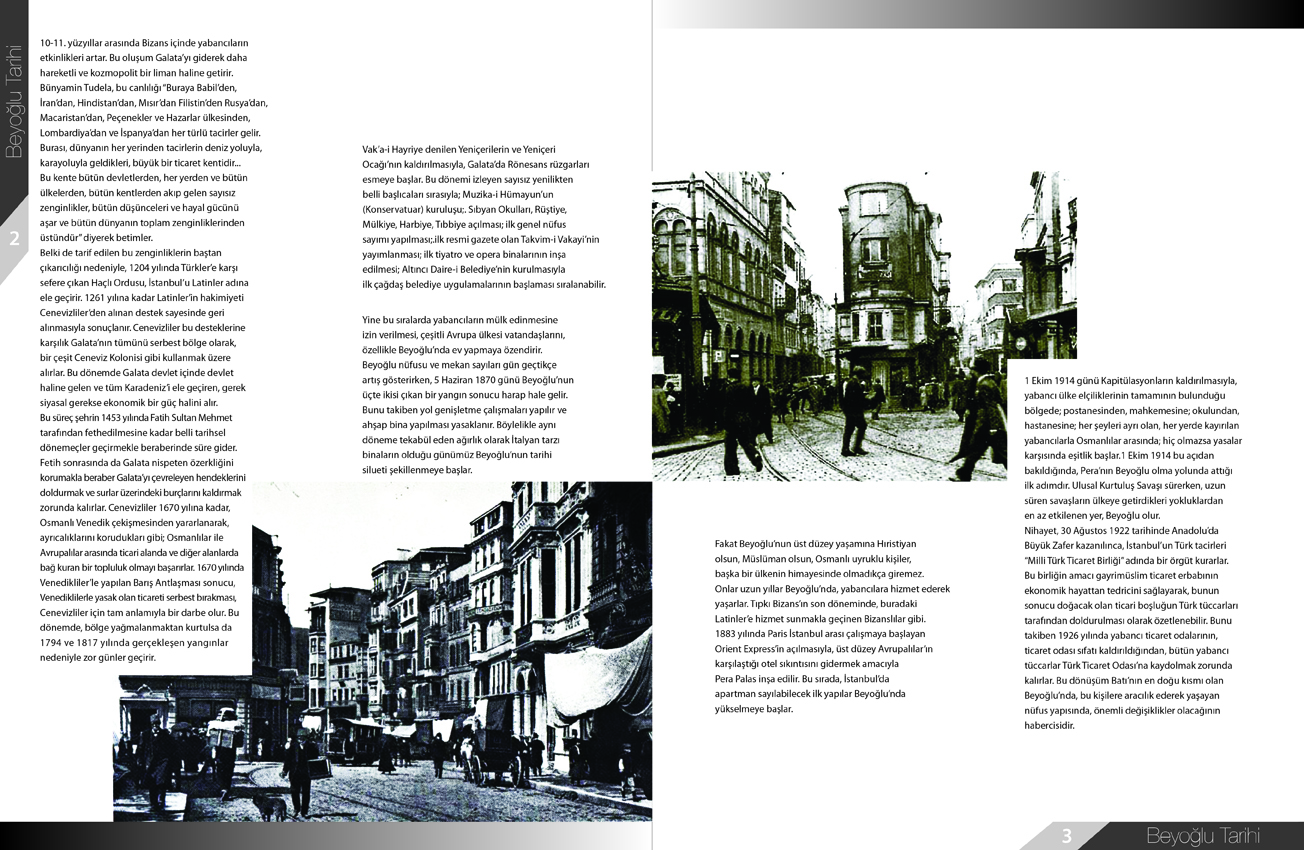
Bu süreç şehrin 1453 yılında Fatih Sultan Mehmet tarafından fethedilmesine kadar belli tarihsel dönemeçler geçirmekle beraberinde süre gider. Fetih sonrasında da Galata nispeten özerkliğini korumakla beraber Galata’yı çevreleyen hendeklerini doldurmak ve surlar üzerindeki burçlarını kaldırmak zorunda kalırlar. Cenevizliler 1670 yılına kadar, Osmanlı Venedik çekişmesinden yararlanarak, ayrıcalıklarını korudukları gibi; Osmanlılar ile Avrupalılar arasında ticari alanda ve diğer alanlarda bağ kuran bir topluluk olmayı başarırlar. 1670 yılında Venedikliler’le yapılan Barış Antlaşması sonucu, Venediklilerle yasak olan ticareti, serbest bırakması Cenevizliler için tam anlamıyla bir darbe olur. Bu dönemde, bölge yağmalanmaktan kurtulsa da 1794 ve 1817 yılında gerçekleşen yangınlar nedeniyle zor günler geçirir.

Vak’a-i Hayriye denilen Yeniçeriler ve Yeniçeri Ocağı’nın kaldırılmasıyla Galata’da Rönesans rüzgarları esmeye başlar. Bu dönemi izleyen sayısız yenilikten belli başlıcaları sırasıyla;Muzika-i Hümayun (Konservatuar) kuruluşu;. Sıbyan Okulları, Rüştiye, Mülkiye, Harbiye, Tıbbiye açılması; ilk genel nüfus sayımı yapılması;.ilk resmi gazete olan Takvim-i Vekayi yayımlanması; ilk tiyatro ve opera binalarının inşa edilmesi;.Altıncı Daire-i Belediye’nin kurulmasıyla ilk çağdaş belediye uygulamaları başlaması sıralanabilir..

Yine bu sıralarda yabancıların mülk edinmesine izin verilmesi, çeşitli Avrupa ülkesi vatandaşlarını, özellikle Beyoğlu’nda ev yapmaya özendirir. Beyoğlu nüfusu ve mekan sayıları gün geçtikçe artış gösterirken, 5 Haziran 1870 günü Beyoğlu’nun üçte ikisi çıkan bir yangın sonucu harap hale gelir. Bunu takiben yol genişletme çalışmaları yapılır ve ahşap bina yapılması yasaklanır. Böylelikle aynı döneme tekabül eden ağırlık olarak İtalyan tarzı binaların olduğu günümüz Beyoğlu’nun tarihi silueti şekillenmeye başlar.

Fakat Hıristiyan olsun, Müslüman olsun, Osmanlı uyruklu kişiler, başka bir ülkenin himayesinde olmadıkça, Beyoğlu’nun üst düzey yaşamına giremez. Onlar uzun yıllar Beyoğlu’nda, yabancılara hizmet ederek yaşarlar. Tıpkı, Bizans’ın son döneminde, buradaki Latinler’e hizmet sunmakla geçinen, Bizanslılar gibi.

1883 yılında Paris İstanbul arası çalışmaya başlayan Orient Express’in açılmasıyla, üst düzey Avrupalılar’ın karşılaştığı otel sıkıntısını gidermek amacıyla Pera Palas inşa edilir. Bu sırada, İstanbul’da apartman sayılabilecek ilk yapılar Beyoğlu’nda yükselmeye başlar.

Bütün bu yenileşme hareketleri içerisinde gelişen Galata ve Pera 10 Temmuz 1894 İstanbul depremiyle sallanır. Bu depremde pek çok kişi çöküntülerin altında kalarak can verir. Ardından bir sene sonra 1895 yılında Galata’da Müslümanlar ile Ermeniler arasında üç gün, üç gece süren şiddet hareketlerinde pek çok kişi ölür. Bütün bu çatışmalar ve 31 Mart Vakasının yarattığı sorunlar, İttihat ve Terakki’nin konumunu güçlendirir. 3 Mart 1910 günü, Ayan ve Mebusan Meclisleri, Fındıklı Sarayı’na yerleşirler. Böylelikle, Osmanlı İmparatorluğu, Beyoğlu sınırları içinde yönetilmeye başlar.

1 Ekim 1914 günü Kapitülasyonların kaldırılmasıyla, yabancı ülke elçiliklerinin tamamının bulunduğu bölgede; postanesinden, mahkemesine; okulundan, hastanesine; her şeyleri ayrı olan, her yerde kayırılan yabancılarla Osmanlılar arasında; hiç olmazsa yasalar karşısında eşitlik başlar.1 Ekim 1914 bu açıdan bakıldığında, Pera’nın Beyoğlu olmak yolunda attığı ilk adımdır.Ulusal Kurtuluş Savaşı sürerken, uzun süren savaşların ülkeye getirdikleri yokluklardan en az etkilenen yer, Beyoğlu olur.

Nihayet, 30 Ağustos 1922 tarihinde Anadolu’da Büyük Zafer kazanılınca, İstanbul’un Türk tacirleri “Milli Türk Ticaret Birliği” adında bir örgüt kurarlar. Bu birliğin amacı gayrimüslim ticaret erbabının ekonomik hayattan tedricini sağlayarak, bunun sonucu doğacak olan ticari boşluğun Türk tüccarları tarafından doldurulması olarak özetlenebilir. Bunu takiben 1926 yılında yabancı ticaret odalarının, ticaret odası sıfatı kaldırıldığından, bütün yabancı tüccarlar Türk Ticaret Odası’na kaydolmak zorunda kalırlar. Bu dönüşüm Batı’nın en doğu kısmı olan Beyoğlu’nda, bu kişilere aracılık ederek, yaşayan nüfus yapısında, önemli değişiklikler olacağının habercisidir.

Ankara’nın başkent olmasıyla, eski başkentin çok önemli kurumlarını, hatta bir ara, parlamentolarını bile sınırları içinde barındıran Beyoğlu, yabancı elçileri Ankaya’ya uğurlarken, ülkenin siyasal sahnesinde çok gerilere itilir.

1930’lara gelindiğinde milliyetçi akımların yükselişi yoğun bir şekilde kendini hissettirmeye başlar. Beyoğlu’nun, Pera’dan miras kalan kültürü sürdürmesi, giderek daha zor hale gelir. 12 Kasım 1942 günü yürürlüğe giren “Varlık Vergisi Kanunu” Pera’nın son kalan ahalisinin sırtına bir bıçak gibi saplanır. Bu süreç içinde, Beyoğlu’nun yeni zenginleri için kaşık havası, rumba karışımı oyunlar oynanırken, eski zenginlerin bir kısmı Aşkale’de taş kırar.

6 Eylül 1955 gününü 7 Eylül’e bağlayan gece, İstanbul’da ve özellikle Beyoğlu’nda inanılması zor olaylar olur. Selanik’de, Gazi Mustafa Kemal Paşa’nın doğduğu eve bir bomba atıldığının duyulması, İstanbul’da da bomba etkisi yaratır. Taksime gösteriye çıkanlar, özellikle Rumlar’ın dükkan ve mağazalarına girerek, talan ederler. Pera seçkinliği, artık yabancılar için ödenmesi bir hayli güç bir bedeldir.

1970’li yıllar, Beyoğlu’nda yaşayan Müslüman olmayan azınlıkların önemli bir bölümünün, ülkeyi bırakıp göç ettiği yıllar olur. !980’li yıllara gelindiğindeyse, eskiden Beyoğlu’nda yaşayan azınlıklardan ülkeyi terk etmeyen bölümünün, Beyoğlu’nu bırakıp, İstanbul’un daha yeni ve modern mahallelerine taşındığı görülür. Böylece Beyoğlu, tarihinde ilk kez, İstanbul’un barındırdığı nüfus yapısından farksız bir nüfus yapısını barındırmaya başlar...